

A homeowner in Scituate called us about a problem that was showing up in the wrong room. There was moisture behind the shower wall, showing up in the next room. Not in the shower. Behind it.
The shower was about 15 years old and looked fine from the inside. The tile was intact. The grout looked okay. So they did what most people do first: they regrouted. Then they waited. The wall stayed damp.
That’s usually the point where a homeowner starts to suspect the problem isn’t cosmetic. By the time we came out to look, the shower floor was already out.
This is what was underneath.
Moisture behind the shower wall: what we found
The shower floor had been built the old way: a mud bed sitting on tar paper over the wood subfloor. The drain was a standard drain with nothing connecting it to any waterproofing layer, because there was no waterproofing layer. Tar paper is all there was between 15 years of showers and the framing of the house.
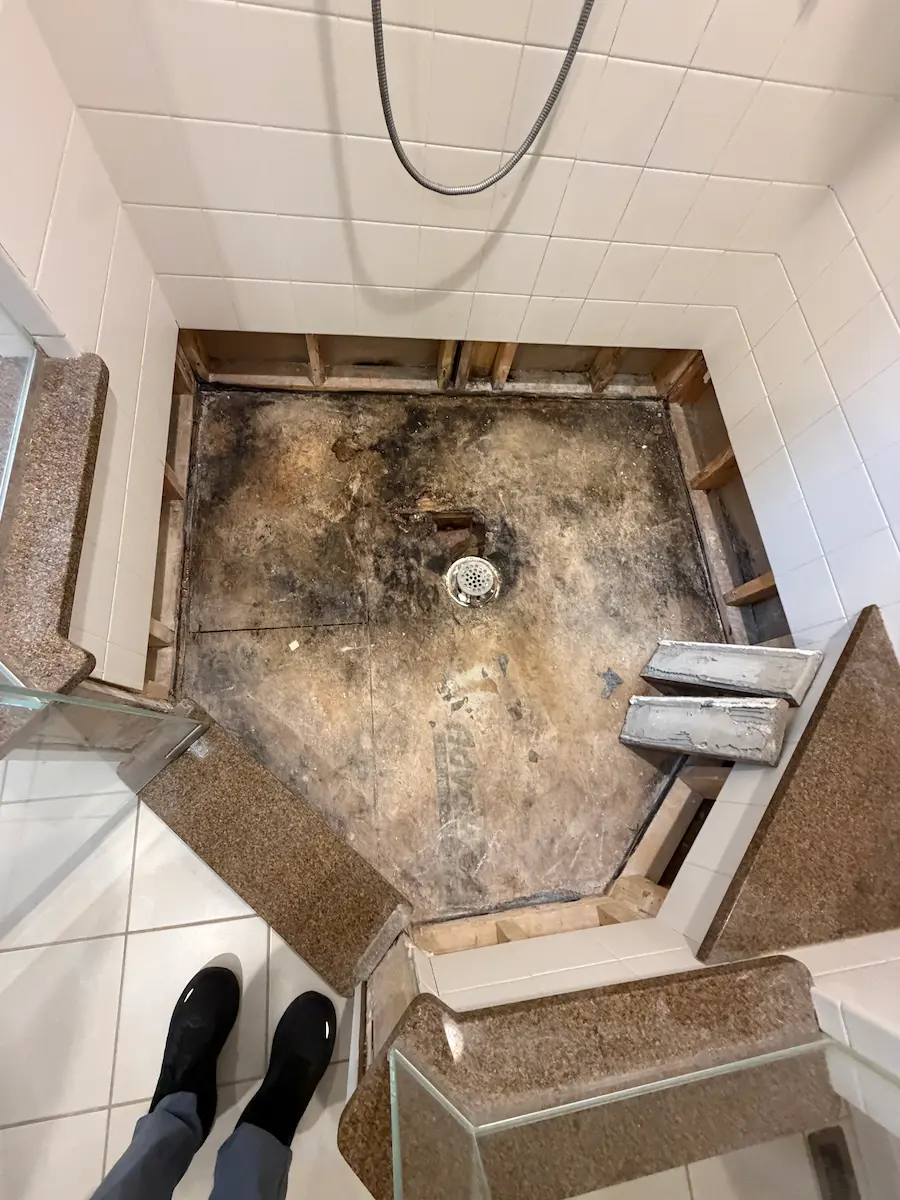
Around the drain, the subfloor had rotted completely through. You could see down into the insulation below. Along the base of the walls, the bottom plate and the wallboard behind the tile were black with water staining.


None of this was visible from inside the shower. The tile above it looked normal.
Why regrouting didn’t work
Grout is not waterproof. It never was. In a properly built shower, grout is a finish. The layer that actually keeps water away from your framing is a membrane underneath the tile. When water shows up on the far side of a shower wall, it means water is getting through the tile assembly and there is nothing under it stopping it. New grout on top changes nothing about that.
If you have a leaking shower and someone tells you regrouting will fix it, ask them what’s underneath the tile. If they don’t know, that’s your answer. Age isn’t the issue either. A three-year-old shower in Newton was missing the same layer.
Why it took 15 years
I don’t have a clean answer for that, and I told the homeowner the same thing. Tar paper is not a waterproofing material. It slows water down but doesn’t stop it. A mud bed holds water like a sponge and dries slowly between showers. Somewhere in that combination, water reached the wood around the drain a little at a time. The framing stayed wet for years before it finally showed on the wall.
That’s the part I want homeowners to understand. This kind of failure doesn’t announce itself. The tile can look fine. The grout can look fine. The damage is happening where you can’t see it, and by the time it shows, the wood has been wet for a long time.
What a shower should have under the tile
Every shower we build in Greater Boston gets a full waterproofing system before any tile goes in. That means a bonded membrane on the floor and walls, a drain that connects directly to that membrane and sealed corners and seams. We install Schluter and Laticrete systems and are certified in both. When water gets past the tile and grout, and over time it always will, it lands on the membrane and runs to the drain instead of into your floor.
The tile is the last thing that goes in. The system under it is what makes the shower last.
How this one ended
After the visit and the estimate, the homeowner chose another contractor for the rebuild. That’s their call and I wished them well. But whoever rebuilds that shower, this is what they need to be asking for: the rotted wood replaced, a bonded membrane on the floor and walls, a drain that connects to it and sealed seams before any tile goes in. Not new grout. Not a new mud bed on new tar paper. If the fix doesn’t include a waterproofing system, the same wall will be wet again in a few years.
If you’re seeing moisture near a shower
If a wall next to your shower is damp, paint is bubbling or a floor near the shower feels soft, regrouting is not the answer. Something underneath has failed, and it needs to be opened up and looked at.
Davie Mac Tile builds and rebuilds showers across Greater Boston, including Scituate and the South Shore. Davi Santos is a CTI Certified Installer and NTCA member with 25 years of experience. Call (508) 728-9775 or see our shower tile installation page.