
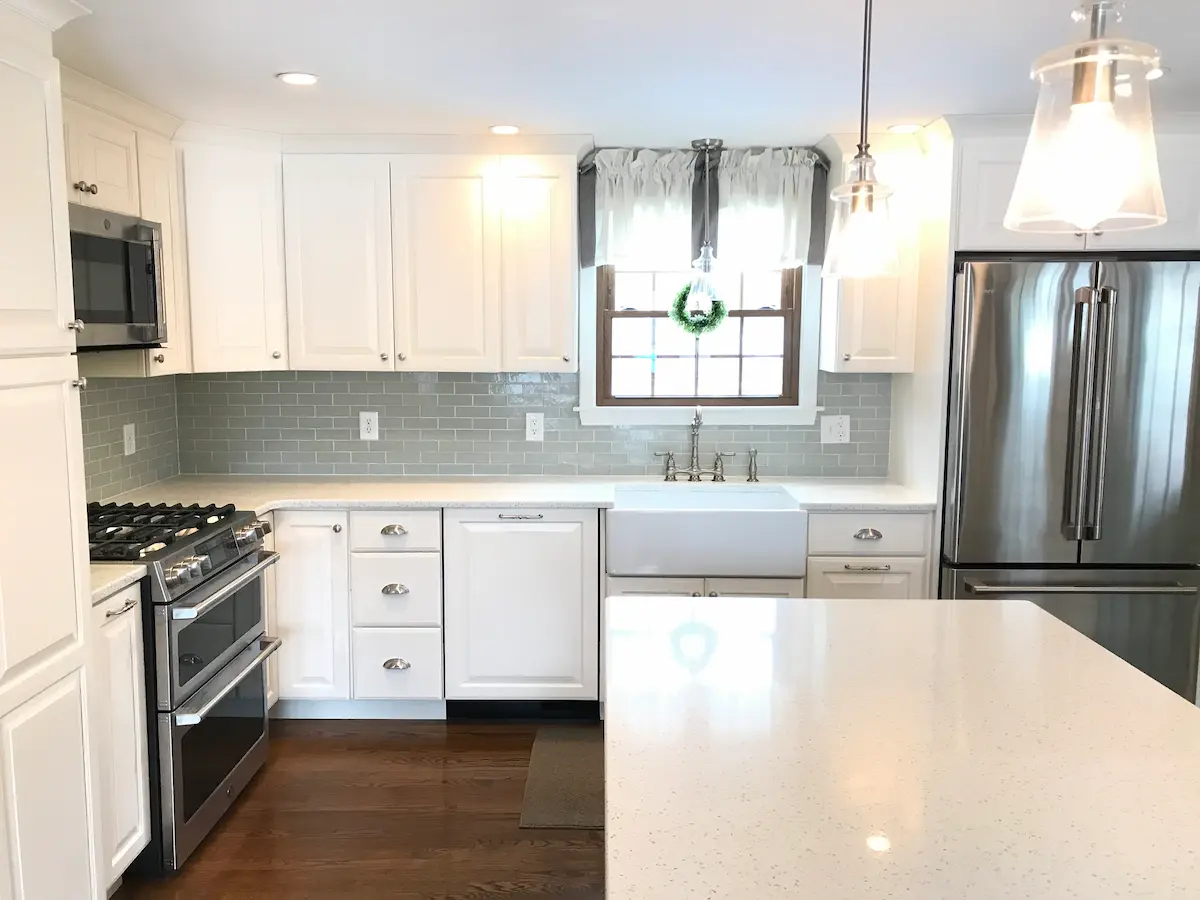
This job in Georgetown, MA started with a backsplash that was already finished. The homeowner had picked a beautiful tile, Fireclay Tile handmade ceramic field tile, 2×6, in the color Oyster Shell. It is made to order in California, and this order was four boxes of a hundred pieces. The kitchen was ready for it: white shaker cabinets, white quartz counters, a farmhouse sink and stainless appliances. A clean, bright kitchen that needed a clean, bright wall.
The previous installer had already set it. The homeowner was unhappy with the result and called me. After 25 years of tile work, I could see why from the doorway. The wall was covered in thin brown lines. We removed everything and did the handmade subway tile backsplash in Georgetown MA over from the start.

What we ran into
The brown lines were not dirt and they were not grout. They were the tile itself. Fireclay makes this tile from a red clay body and glazes the face. The glaze is thick on the face and thins out toward the edges, so on a lot of pieces the red clay shows through right at the edge. Hold one loose tile in your hand and you can see it: a soft white face with a brown rim around it.

That is part of the character of handmade tile, and it is fine as long as the edges stay where they belong, tucked into the joint and under the grout. On this wall they did not. The pieces had not been sorted, so tiles with heavy brown edges were set wherever they landed. Cut edges were left exposed. And the joints were uneven, so in a lot of spots the grout did not cover the edge at all. Put all of that together and the brown rims turned into lines running across the whole kitchen.
This is why handmade tile has a reputation for being hard to install. Fireclay says the size and thickness of this tile can vary by up to about 1/8 inch from piece to piece. On a machine-made subway tile, every piece is the same and the wall almost lays itself out. Here, every piece is a little different. If you set it the way you would set a factory tile, the joints wander, the faces stair-step and you get lippage, where one tile sits proud of the one next to it. The edge glaze is thick and uneven, so some edges are worse than others. And the shade varies, so you have to blend pieces across all the boxes or one section comes out darker than the rest.
There was one more problem that decided the whole job. Because this tile is made to order, a new batch may not match the first one. That means you cannot patch a wall like this. You cannot pull the worst pieces and swap in better ones from a reorder, because the new pieces may read a different shade next to the old ones. It was all or nothing.

How we handled the handmade subway tile backsplash in Georgetown MA
We took the whole wall down to clean substrate. Fireclay shipped a rework order for the redo, so we were starting with fresh tile.
The work that matters on a tile like this happens before any of it goes on the wall. I opened every box and sorted every piece. Each one was checked for size, for thickness and for how much brown showed at the edges, and the boxes were mixed so the shade blended across the whole backsplash instead of changing from one box to the next. The pieces with the cleanest edges went where the eye lands first, behind the range and under the microwave. Pieces with heavier edges were turned so the better edge faced out, or saved for spots where a cabinet or the counter would cover the worst of it.
Then the setting. With a tile that varies in thickness, you cannot set it to the back. The wall is flat, but the tile is not, so if you push every piece to the substrate the faces come out at different heights. I set each piece to the face, adjusting the mortar behind it so the fronts line up and the wall reads flat. That is slower, but it is the only way to get rid of lippage on handmade tile.
The layout is a running bond with tight joints and white grout. Fireclay recommends a 3/16 inch joint for this tile, which gives you room to absorb the size variation. I went tighter, because a tight joint with white grout lets the tile read as one soft gray-green field, and the joint is the one thing that stands out on a wall like this. A tight joint on a tile that varies this much only works if the sorting was done right. The sorting is what makes the tight joint possible. The white grout does the rest, filling the joint flush so the edge of every piece is buried and none of that brown rim has anywhere to show.
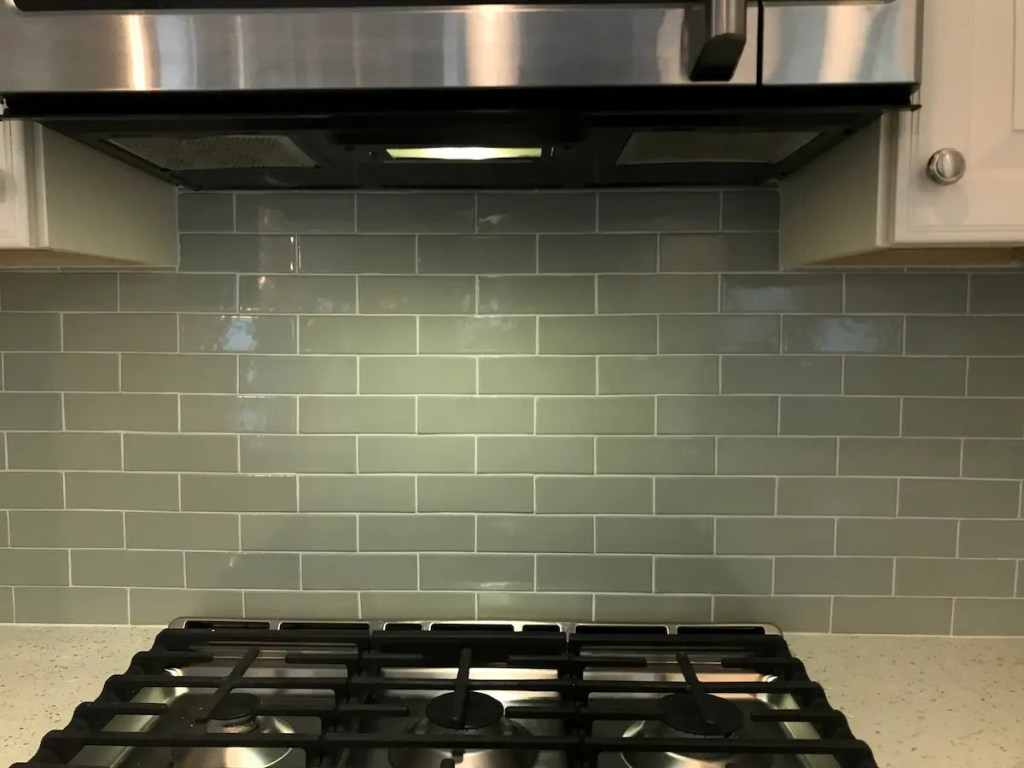
Every cut edge was hidden. Cuts went into corners, under the uppers and against the counter, never out in the open where the raw clay would show.
The result
The wall now looks the way the homeowner pictured it when she ordered the tile. Oyster Shell reads as a soft gray-green, a little different from piece to piece, with the hand-made texture and glaze movement that is the whole reason to buy this tile. No brown lines. The range wall and the window wall carry the same shade and the same joint from end to end, and the whole thing sits clean against the white cabinets, the quartz and the farmhouse sink.
If you are planning a handmade tile backsplash
Handmade tile is worth it, but it does not forgive a fast install. Three things to know before you hire someone. First, ask how they sort. If the answer is that they open a box and start setting, that is how this wall ended up the first time. Second, ask whether they set to the face or to the back. With tile that varies in thickness, setting to the face is the only way to avoid lippage. Third, order enough the first time. Reorders may not match, and a wall like this cannot be patched later.
If you already have a wall with brown edges showing, the honest answer is usually a full redo, not a repair. I know that is not what anyone wants to hear. But I have been setting tile since 2001, and I have never seen a patch on handmade tile that did not look like a patch.
Check the tile before anyone sets it
One more thing this job brings up. Handmade tile is made to order, and sometimes the manufacturer gets it wrong. The color comes in off from the sample, a batch runs more varied than expected, or the edges are rougher than the showroom piece. It happens. It only becomes a real problem the day the tile goes on the wall.
A word to the homeowner: open the boxes when they arrive, not the morning the installer shows up. Lay a dozen pieces on the counter in daylight next to your sample and look at the faces and the edges. If something is off, that is the time to call the supplier, while the tile can still go back. Once it is set, the only fix is the one we did here.
A word to the installer: do not rush. If the tile looks different from what the customer showed you, or you open the boxes and something feels wrong, stop and ask before you mix mortar. This has happened to me a couple of times in 25 years. I always check with the customer first, especially when I can tell something is amiss. A short conversation costs nothing next to tearing out a finished wall.
This handmade subway tile backsplash in Georgetown MA was held to the same standard as every backsplash tile installation we do. If you are in Georgetown or anywhere in Greater Boston and you are choosing handmade tile, or you have one that did not come out right, I am happy to take a look.

Davie Mac Tile installs backsplashes across Greater Boston, including Georgetown. Davi Santos is a CTI Certified Installer and NTCA member with 25 years of experience. Call (508) 728-9775 or see our backsplash tile installation page.