

Massachusetts doesn’t require a license to install tile. There’s no exam, no certification requirement, no oversight. Anyone can buy a trowel, put up a website, and start taking jobs tomorrow. And across Greater Boston, many do. This page explains why that matters — and what it can cost you.
A Real Story From a Boston-Area Homeowner
A homeowner I’d previously worked with at his Boston South End residence in 2017 moved to the suburbs during Covid and built a new home. He wanted me for the tile work again. His builder insisted on using his own crew instead.
The builder’s crew installed a marble shower in the master bathroom. Within a couple of years, the homeowner noticed brown stains spreading across the marble, grout cracking throughout, and tiles beginning to loosen. He called me to come assess the situation.
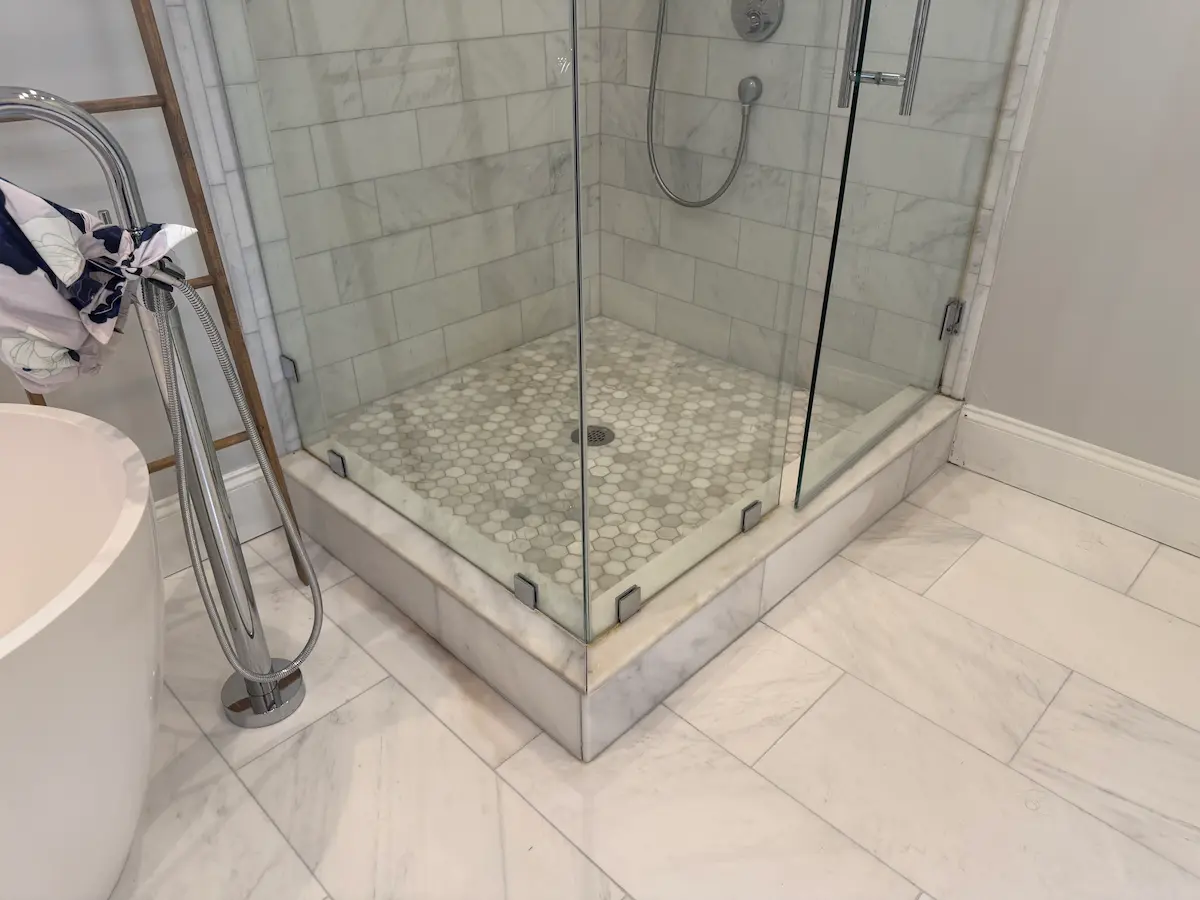
Marble shower showing cracked grout, brown staining, and early signs of water infiltration — all visible from the surface.
The problems were immediately obvious. No proper waterproofing. Marble set with the wrong adhesive. Grout cracking at every joint. Water had been getting behind the tile since day one, and the marble — being porous — had absorbed it, staining brown from the inside out.
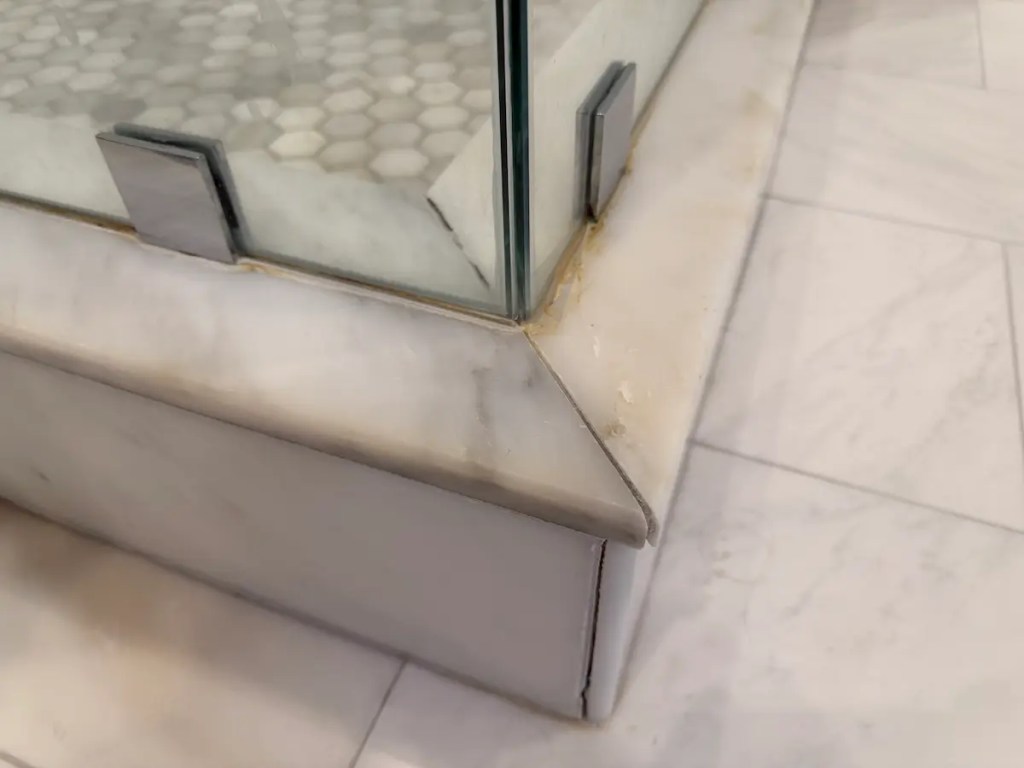
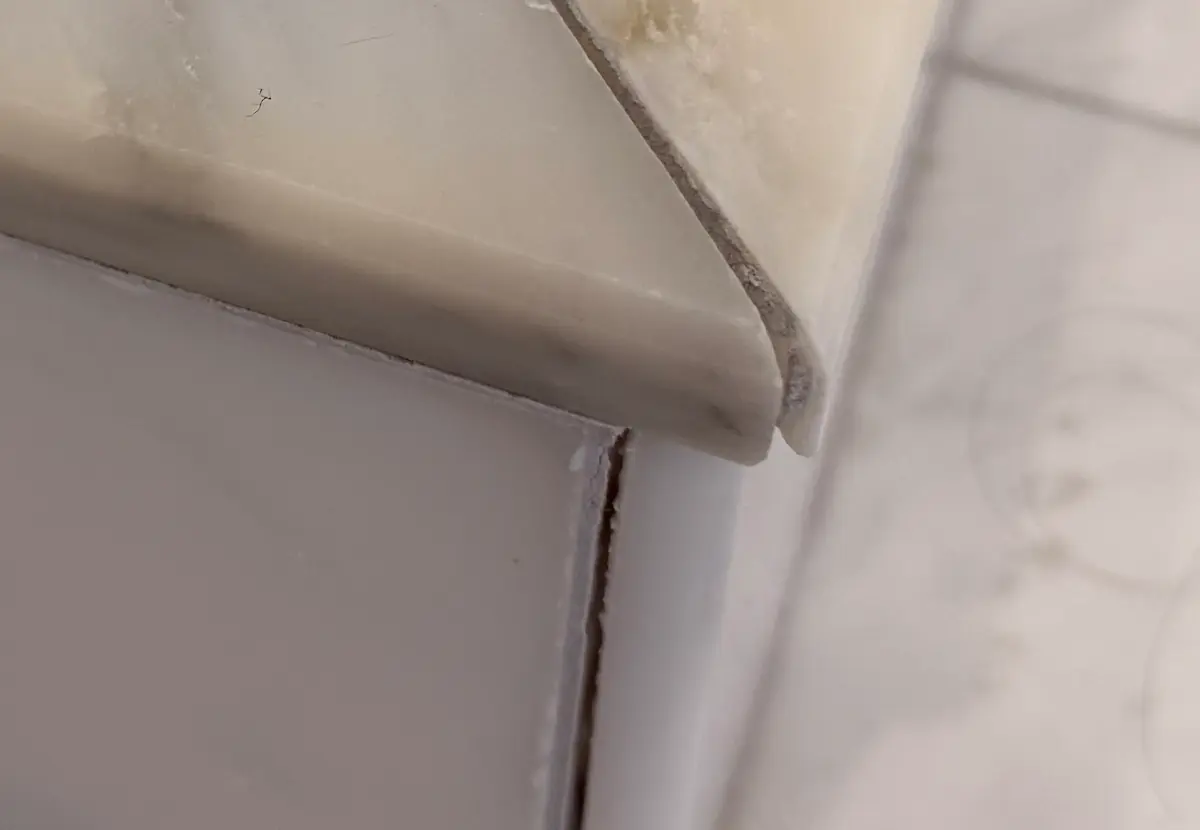
Left: cracked curb with failing caulk joints. Right: corner separation where water had been entering for years.
This wasn’t a cheap home. This wasn’t a budget project. The homeowner paid full price for what he thought was professional work. The only thing missing was a qualified installer.
What happened next? The homeowner eventually removed the tile himself to see the damage behind it. What he found — rotted framing, no waterproofing membrane, mold — confirmed what I suspected during the assessment. The entire shower needs to be torn out and rebuilt from scratch. Full case study coming soon.
The Industry Problem Nobody Talks About
There’s almost no barrier to entry in the tile installation trade. Massachusetts doesn’t require a specific license to install tile. No exam. No apprenticeship. No proof of competence. Anyone can call themselves a professional tile installer and start taking your money.
Many of the lowest-priced installers across the Greater Boston area operate without general liability insurance, without workers’ compensation coverage, and without any industry credentials. They have no investment in their reputation, no intention of being around long-term, and no accountability if something goes wrong. If your shower leaks, your marble stains, or a worker gets injured on your property — you have no recourse. They’re gone, and you’re left paying to fix it.
The corners they cut aren’t just in materials — they’re in time. Proper waterproofing, correct substrate preparation, careful leveling, and thoughtful layout planning all take real time and skill. Installers focused on speed over quality do just enough for the job to look acceptable until they collect payment and move on to the next one.
This isn’t a theoretical problem. We see the results of it across Greater Boston constantly — in Newton, Brookline, Cambridge, Weymouth, and everywhere in between. Homeowners calling us to assess showers that are two or three years old and already failing.
What Homeowners Risk With an Unqualified Installer
When a tile project — especially a shower — falls into the wrong hands, the consequences go far beyond cosmetic issues:
- Water infiltration: Without proper waterproofing, moisture seeps behind the tile every time you shower. This damage is invisible until it’s severe — rotted framing, deteriorated subfloor, and compromised structure.
- Marble and natural stone discoloration: Porous stone absorbs water from behind when waterproofing is absent. The result is permanent brown or yellow staining that can’t be cleaned — only replaced.
- Grout failure and loose tiles: Incorrect thinset, improper substrate prep, and lack of expansion joints lead to cracking grout and tiles detaching from the wall or floor. Beyond looking terrible, this creates safety hazards.
- Mold growth: Persistent moisture behind tile creates ideal conditions for mold — a health risk and a problem that often requires professional remediation beyond just replacing the tile.
- No insurance protection: If the installer doesn’t carry liability insurance or workers’ comp, and someone is injured on your property or damage occurs to your home, you carry the risk.
The worst part: by the time you see the damage on the surface, the problem behind the wall has been developing for months or years. The repair almost always costs more than doing it right the first time.
How to Verify a Tile Installer Before You Hire
You don’t need to become a tile expert — you just need to ask the right questions. Here’s what to look for when evaluating any tile installer in Massachusetts:
Ask for their CTI number. The Certified Tile Installer credential, issued by the Ceramic Tile Education Foundation (CTEF), requires passing both a hands-on and written exam. Less than 5% of tile installers in Massachusetts hold it. If they have a number, you can verify it. If they don’t, ask why.
Ask for proof of insurance. General liability and workers’ compensation. Not just “yes, I’m insured” — ask for the certificate. Any legitimate contractor will provide it without hesitation. If they can’t or won’t, walk away.
Ask about waterproofing. Specifically: what system do they use, and are they certified in it? A qualified installer will name specific products — Schluter Kerdi, Laticrete Hydro Ban, GoBoard — and explain why they chose that system for your project. An unqualified installer will either skip the topic or give a vague answer.
Ask for recent local references. Not just photos — actual homeowners you can contact in the Greater Boston area. Someone who did a shower last month, not three years ago. A professional with a solid track record will happily connect you with past clients.
Check their Google reviews. Not the number of stars alone — read the reviews. Look for specifics: communication, cleanliness, attention to detail, waterproofing mentioned. Generic one-line reviews mean less than detailed accounts of actual work.
Ask if they belong to the NTCA. The National Tile Contractors Association is the industry’s professional organization. Membership indicates a commitment to standards, continuing education, and proper installation methods.
Don’t Let Your Builder Choose Your Tile Installer
This is one of the most common mistakes we see. A homeowner is doing a renovation or building a new home, and the general contractor insists on using his own tile crew. The homeowner goes along with it — after all, the builder should know best, right?
Not always. Many builders choose their tile crew based on price and availability, not skill. They have preferred teams because those teams are cheap and fast — not because they’re qualified. The builder’s priority is staying on budget and on schedule. Your priority is getting tile work that lasts decades.
Those priorities don’t always align.
It’s your home and your money. You have every right to hire your own tile installer, even during a general contractor-managed project. A good builder will respect that. A builder who refuses to let you choose your own qualified installer is telling you something about their priorities — listen to that signal.
The marble shower failure photos on this page exist because a homeowner trusted his builder’s crew instead of insisting on a qualified installer he’d already worked with. That’s not an unusual story. We hear versions of it regularly across the Boston area.
Why Davie Mac Tile
We’ve been installing tile across Greater Boston since 2001. We’ve earned every credential, every review, and every returning customer the hard way — through 25 years of showing up, doing the work right, and standing behind it.
- Certified Tile Installer (CTI) #1344 — issued by the Ceramic Tile Education Foundation (CTEF)
- National Tile Contractors Association (NTCA) member
- Schluter Systems certified installer
- Laticrete certified installer
- Large Format Porcelain certified (NTCA)
- BBB Accredited — A+ rating
- 75 five-star Google reviews — perfect 5.0 rating
- General liability insurance and workers’ compensation coverage
- Written 2-year workmanship guarantee on every new installation
We pay our taxes. We carry real insurance. We’ve invested in certifications that most installers never pursue. And we’ve been operating as a legitimate Massachusetts business for a quarter century. When you compare us to an unlicensed installer offering a lower price, you’re not comparing the same thing.
Frequently Asked Questions
Do tile installers need a license in Massachusetts?
No. Massachusetts does not require a specific license to install tile. There is no state exam, no apprenticeship requirement, and no oversight body. This is why verifying credentials like CTI certification, NTCA membership, and proof of insurance is so important — it’s the only way to distinguish a qualified professional from someone who started last month.
What is CTI certification and why does it matter?
CTI stands for Certified Tile Installer. It’s a credential issued by the Ceramic Tile Education Foundation (CTEF) after passing both a hands-on installation test and a written exam covering industry standards. Less than 5% of tile installers in Massachusetts hold it. It’s the closest thing the industry has to a license — and it’s voluntary, which means the installers who have it sought it out because they take the trade seriously.
How can I tell if a tile installer is qualified?
Ask for their CTI number (and verify it on the CTEF website), request proof of general liability insurance and workers’ compensation, ask what waterproofing systems they use and whether they’re certified in them, check their Google reviews for detailed feedback, and ask for recent references from homeowners in your area. A qualified installer will welcome these questions — an unqualified one will dodge them.
Should I let my builder choose the tile installer?
Not necessarily. Many builders choose tile crews based on price and availability rather than skill and credentials. It’s your home and your investment — you have the right to hire your own qualified tile installer even during a builder-managed project. A good builder will respect that decision.
What happens if an unqualified installer does bad work?
If the installer has no insurance, no business entity, and no accountability, you have very limited recourse. You’ll likely need to hire a qualified installer to tear out the failed work and rebuild it properly — at your own expense. For showers especially, the cost of a rebuild is almost always more than the cost of doing it right the first time.
Don’t Risk Your Home on the Wrong Installer
25 years of experience. CTI certified. Fully insured. Every installation backed by a written guarantee.
Get a Free Estimate
or call (508) 728-9775